“You basically have to be an acrobat on a pole and still look beautiful. You are selling a fantasy. Men are paying us to be teased… it requires having thick skin and confidence to make as much as you possibly can,” said Pocahontas, 24, from California.
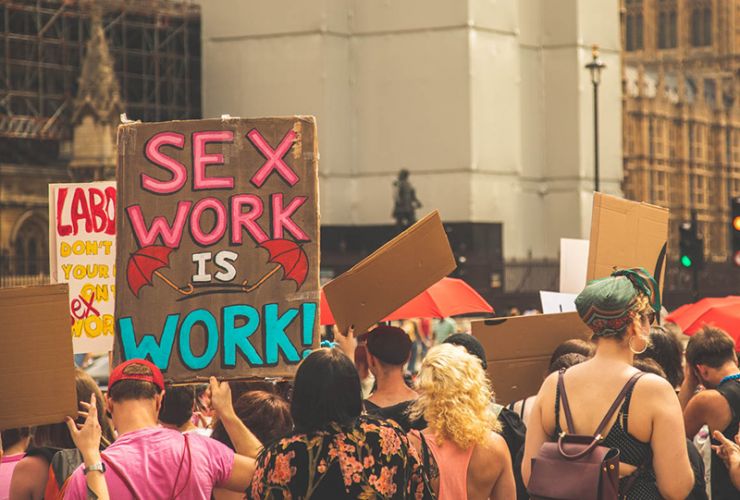
Sex work is the exchange of sexual services for monetary compensation. The term “sex work” acknowledges sex work as real labor instead of the primary term “prostitution,” which stigmatizes sex work as criminally and morally wrong.
There are different types of sex work. There are adult film performers, phone sex operators, webcam girls, dancers at strip clubs, and others who provide sex-related services.
According to the Sex Pop-up Organization, sex work is misunderstood, misrepresented, and highly stigmatized and criminalized in most countries. They feel that labeling sex workers as villains or victims won’t improve our society, but giving proper labor protections and human rights will.
These issues were addressed on March 13, when the organization held an exhibition in New York City, featuring the artwork and performances from sex workers around the world while giving discussion panels on advocates for improving the lives of sex workers.
***
Pocahontas, a 24-year-old stripper from California, was introduced to the industry after needing financial stability due to losing her job at a call center. She had been living on her own since she was 16 because her parents suffered from addiction.
“I never wanted to be like them. I wanted better for myself and I needed to be financially stable so after I was fired, I went in for my audition and danced to two songs. I had no idea how to pole dance and never had training but I knew the DJ and he thought I had potential, so I was hired on the spot and didn’t even need to see the house mom,” she said.
Strip clubs do not have a Human Rights Department and most females have to file taxes as freelance agents and file taxes accounting for their own money, in order to collect unemployment during a time like this current pandemic.
“I definitely feel like we have less rights than average people because there is no HR department, so House Moms can talk to you however they want and you can’t do anything. I’ve had a boss call me a “dumb whore” and kick me out of the club over rumors from another jealous girl. He threw the money I made that night at my face and pushed me out the door into a puddle. When I went to report it to the police as harassment, they sided with him.”
She has begun dancing since October, therefore has not filed taxes as a dancer to account for her wages and is unable to make money now that the clubs are closed.
Under normal circumstances, Pocahontas can make up to $4,000 a month.
“A lot of people think they can just become a stripper out of high school and make money easily and while I think anyone can learn, it requires hard work and discipline not only physically but mentally. I try to push myself to work five nights a week and I’ll do 8-hour shifts. It usually allows me to pay all my bills for the month but every night is different. Some nights are slow and I won’t make anything, other nights I’ll leave with $700. It all depends. You also have to keep in mind we pay a high house fee at my club, plus we have to give up 50 percent of our lap dances and keep all the tips we make on stage. That’s why I make sure I work those days and hours so that it all evens out.”
It is a highly competitive industry too and can affect some girl’s mental health. However, she maintains her own personal values to keep everything professional at her club.
“I feel like I have thick skin and don’t take things personally when getting rejected because every guy has a type. You do have to keep up with beauty regimens because you want to look your best and you are selling a fantasy. My secret is just my people skills. I know how to talk to guys, some will just pay me to sit on their lap and talk and listen to them,” she said.
“I have strict boundaries for myself and I don’t let any guy talk to me any kind of way or touch me on the floor, but I have obviously seen girls who let guys touch them for more and who just drink their whole shift and throw up in the dressing room the rest of the night. The girl’s drug of choice at the strip club is cocaine, and the photographer even sells it to them but our House Mom doesn’t care.”
A House Mom is hired by strip clubs to enforce the club’s rules about the dress code, schedule and conduct. Yet they also supply dancers with hygiene products, organize stage schedules, help with makeup and food, along with other tasks.
She says there is a stigma that all sex workers are “sexed crazed” individuals and it can be difficult to navigate intimate relationships, she says.
“I feel like we are so sexualized during are job that once I get home, I just want to rest and get things done around my house. I think most girls I know who danced either have no sex life or are married. It can be difficult to find a partner because for me personally, I feel that guys are either too insecure and think that my job is cheating so they can go cheat, or guys expect me to be their sugar momma and pay for everything and I feel that if you can’t match my hustle, you are wasting my time.”
Pocahontas does not plan on dancing forever. She wants to use the job to pay for her school and get her major in Music Education Management, and one day wants to manage artists and run her own studio.
“I know this isn’t a forever job, but I want to use my advantage so that I can make my dreams come true. I do like how it provides me financial security and allows me to have a flexible schedule, but some of the working conditions at some clubs are awful. I’m happy at the club I’m at now, and I’m saving my money to pay for school so that I can get out and start my career.”
***
Lola Lightning, 23 from New York, has been dancing and using webcamming for a year.
“I have always liked being naked and being an exhibitionist. Sex workers’ rights to me would mean that we don’t get stigmatized and just get looked at by society as people who have a high paying job,” she said.
Usually, Lola makes around $5,000 a month. She is currently using the money she earns to pay her way for school for her to get her degree in Digital Communications and Media and eventually get into web coding.
“ I feel like sex work has affected my mental health in positive ways. It has allowed me to figure out what I really want out of life. I aim to eventually move on to other things and have lots of different endeavors.”
“I think a common misconception people have about us is that we’re sex-crazed nymphomaniacs. Only on the weekends,” she laughs.
A new popular platform for sex work has been the app called OnlyFans. OnlyFans is a subscription-based content service based in London, United Kingdom. Content creators can earn money directly from their subscribers or “fans.”
OnlyFans was launched in 2016 as a website for social media performers to allow their followers to subscribe for a monthly fee to see clips and photos.
OnlyFans have put X- rated content back in the hands of entertainers. Gay performer, Matthew Camp, told the New York Times that he makes $10,000 a month off of his content. The website has even risen in popularity after Beyonce referenced it in the Savage Remix with Meg the Stallion. That alone has uptick the site 15 percent in traffic.
Livvy, a 19-year-old OnlyFan content creator from Nevada, has been creating content for a couple of months after the pandemic shut down her retail job.
“I started on the site because I was laid off by my job during the COVID shut down and I needed to help my boyfriend with our rent, and unemployment in Nevada is backed up.”
Like most sex work, there is a stigma around content creators who use OnlyFans. It is a controversial topic on social media.
“I think a misconception about it is that I don’t ‘respect’ my body and that I have let myself go down the wrong path which doesn’t make sense because at the end of the day I’m making money and people appreciate my work. I feel like I’m loving my body more than I ever have.”
As of May 2020, the site has 30 million registered users and claims to have paid out $725 million to its 450,000 content creators.
“I think it takes confidence and being proud of your work. You need to be willing to please and not apologize for who you are.” Livvy implements her boundaries to her “fans” by making it clear that she does not do hookups and never sends content they have not paid for.
“Most of my subscribers are very sweet. I love the community I created for myself. Some of them feel entitled to me but that comes with the work. For the most part people just want to express their fandom and help me financially in any way they can,” Livvy said.
There are a lot of legal issues when it comes to sex workers. Prostitution is illegal in the majority of the United States. There are different types of sex work, but the same laws and legal issues apply to each and every one of them. An example is in New York sex workers can be fined up to $500 or can be put in jail for up to three months. Sex workers in Louisiana are even required to register as a sex offender if they are prosecuted.
Sex workers can be fined with crimes ranging from minor infractions like loitering or more serious crimes like tax evasion, because sex work is off the books, meaning the IRS doesn’t know about the money coming into that person’s hand or bank account. This is why sex workers are usually paid in full of cash. Not only can the sex worker be charged, but so can the client who solicited.
The National Institute of Justice conducted a study in 2008 that found out 15 to 20 percent of men in the country have engaged in commercial sex. Commercial sex is defined as the exchange of money or goods for sexual services. Men who get caught in engaging in commercial sex may be offered a class or series of classes at a John School. John Schools offer classes to be completed by individuals who are arrested for purchasing sex with an adult. Men who purchase sex from anyone under the age of 18 are not allowed to complete these programs. In some states, the completion of John School can result in the removal of charges on one’s criminal record while in other states one may have to attend John School after being placed in jail.
John Schools teach classes that help inform men who buy sex as a form of educational invention. According to the International Academy of Trial Lawyers, “classes teach the belief that the risk of arrest and legal sanction are low, denial or lack of knowledge of the risk of getting STDs or HIV through purchased sex, ignorance of the risk of being robbed or assaulted by prostitutes or pimps, denial or lack of knowledge or understanding of the negative impact prostitution has on the neighborhoods which it occurs, lack of knowledge or understanding of the links between street prostitution and larger, organized systems of sex trafficking, denial or lack of awareness of what motivates them to solicit prostituted women or girls, denial or lack of awareness of the negative impact of prostitution on “providers”, denial of the fact that money is the only reason prostituted persons have sex with them, the mistaken belief that the women they hire care about them, and that they are in some kind of relationship with them, and the denial or lack of knowledge of the anger, revulsion, or indifference that many prostituted women have while they are having sex with men.”
There are four types of sex work that is illegal in the United States. Street prostitution, brothels, escorting, and child prostitution, which the highest concern in the United States.
***
Ex-child prostitute, Luna, 20 from Brooklyn, got into the “sex industry” at only 17-years-old after his father kicked him out of his house. As a child, he was sexually and physically abused by his father. Luna felt this was the only way he could make a living for himself at only 17.
“I would advertise my body on Instagram and Snapchat. I would hook up with men for money. I also did it for protection because in the hood, people want to mess with gay boys like me. Basically I had a pimp and he would provide everything for me – food, shelter, and clothing.”
He lived with his sugar daddy for three years and was never given money directly, just a stable place to stay in exchange for sex.
“A misconception people have is that they think it’s safe, when it’s not. It’s the worst industry to be in because once you are in, you are hyper-sexualized forever.”
Being a child prostitute has been detrimental to Luna’s mental health. He suffers from severe PTSD, depression and anxiety.
“It kills your ego, value and self-worth and puts you in a category box that no one wants to be in. I think sex workers’ rights should mean having respect and boundaries for us because we are viewed as slaves.”
Luna has trouble maintaining personal and romantic relationships due to his past.
“I feel that people don’t value me as a person and they see me as an object. One thing I do like about the industry is the fluidity and acceptance that comes within the community. My least favorite is the hypersexualization, discrimination and abuse,” he said.
Street prostitution is defined as a form of sex work in which a sex worker solicits customers from a public place, most commonly a street while waiting at street corners or walking alongside a street but also other public places such as parks and benches. Also mentioned is that the street prostitute is often dressed in a provocative way. Street prostitutes are known as the outdoor workers.
Outdoor workers see a higher percentage of abuse from bosses, people who buy from them, or other types of things. About 37 percent of outdoor workers are robbed, 27 percent are beaten, 47 percent are slapped, punched, or kicked, 22 percent are raped, and 20 percent are kidnapped.
On the other hand, the indoor workers who usually work as escorts or brothels see a lower percentage of abuse but still have some. Roughly 10 percent are robbed, 1 percent are beaten, 14 percent are slapped, punched, or kicked, 2 percent are raped, and 2 percent are kidnapped. This is usually because the indoor workers are being watched like in a brothel.
Brothels are defined as a house where men can visit prostitutes. These prostitutes work under a boss, which means that a percentage is taken out of their earnings, even though this may not be a great scenario for them, it helps keep them safe. Brothels and prostitution are illegal but in Nevada they aren’t. In Las Vegas, Reno and Carson City is where most of brothels and prostitution goes on. These cities are where 90 percent of the population of Nevada lives. Also, eight counties in Nevada have active brothels. Brothels in Nevada have to be in a remote location far from schools and churches. They are mostly located off a busy road where there are pawn shops and gun stores.
Brothels may be found in red-light districts. Red-light districts are a part of an urban area where a concentration of prostitution and sex-oriented businesses are found. These businesses include but are not limited to sex shops, strip clubs, and adult theaters. Some of the most popular red-light districts are located in Amsterdam, Louisiana, and other touristy places.
An escort is different from a prostitute. An escort is either an entertainer or a companion for someone that hires his or her services, meaning that these types of women or men do outcalls while prostitutes stay in one area or place like a brothel. These escorts may provide a date to an event or it may just be someone to spend time with. Escorts never have to offer sex to the person who hires them or even promise sex to the person. While escorts are accepting money for attention from a male or female, they do not accept money for sex like prostitutes. Even though they aren’t necessarily giving sex to men, they do risk being arrested or fined for tax evasion or soliciting.
It’s not uncommon to see a street prostitute as is portrayed in movies, and can even be seen in places where it is legal. Prostitution was also legal in Rhode Island until 2009, the only thing that was illegal as street solicitation, brothels, and pimping. Pimping is usually illegal to keep those who do prostitution through a pimp safe. Most pimps abuse their workers and take percentages from them that leave workers with barely any money.
Pimping is not a misdemeanor like prostitution is. Pimping is a felony. Committing this crime may subject a person to over a decade of jail time or thousands of dollars in monetary punishment depending on the state law and whether the sex worker was a minor or not. There are defenses that could help one who is found in this situation, just like every other criminal charge. A defendant, according to a criminal law website, criminal.findlaw.com, states that one can plead for insanity, entrapment, mistake of fact and involuntary intoxication. They also mention that even though one can plead these, it depends on the situation.
Even though these are illegal in the United States, there are websites like OnlyFans and Pornhub that allow social influencers or normal everyday people post nude photos of themselves. These websites even have certain rules that help keep their users safe.
Under OnlyFans’ terms and conditions, rule 9.2.5 states “9.2.5 copy, reproduce, distribute, modify, or create derivative works from, any portion of OnlyFans without FILexpress written permission.” The next rule, 9.2.6 states, “9.2.6 use OnlyFans for the purpose of exploiting, harming, or attempting to exploit or harm minors in any way by exposing them to inappropriate content, asking for personally identifiable information, or otherwise.” This helps anyone safe due to the fact that anyone can subscribe and screenshot or record what has been placed on there.
The same with Pornhub as well. Pornhub keeps their pornstars safe with certain rules on their website. In their terms and conditions, they mention, “use of any manual process to monitor or copy any of the material on the Websites or for any other unauthorized purpose without our prior written consent,” which helps keep pornstars and models safe of anyone copying and reposting their work without being paid. Pornhub also protects 18-year-olds by mentioning “posting any content that depicts any person under 18 years of age (or older in any other location in which 18 is not the minimum age of majority) whether real or simulated.”
Now with these things becoming more popular, sex workers and others like feminists are coming together to work on decriminalization of prostitution and any other sex work. YouTubers are speaking out about these things more than ever right now to bring awareness to viewers about sex work. One major YouTuber who speaks about her time as a stripper is Trisha Paytas, and how it seriously helped her make money, but she also speaks about the negative events that she went through. Another YouTuber who is a huge Pornhub star is Lena The Plug, and she actively speaks about her sex life to her viewers which is bringing light to pornstars, strippers, and other sex workers.
***
Sex work has a long history around the world, with its movements starting around 1915.
In 1915, May “Maimie” Pizner began labor organizing for sex workers in Montreal. She established an apartment in the Redlight district for sex workers to gather, socialize, and rest. Pizner viewed sex workers as “proud, dignified, autonomous women.” Her benefactors gave the apartment the name “Montreal Mission for Friendless Girls,” however Pizner found it to be derogatory.
Pizner was a sex worker her self. Following her father’s murder, Pizner dropped out of school and began work as a sex worker and salesgirl. She spent her teens in and out of jail, eventually losing an eye, but despite these challenges, she spoke five languages and was a talented writer.
In 1949, Dutch Caribbean island Curaçao opened the largest brothel in the Western hemisphere at that time. Called Campo Alegre, the brothel brought in migrant sex workers from throughout the Caribbean to cater to the needs of male migrant workers, Dutch marines, and U.S. military personnel.
From 1949 to 1996, Kamala Kempadoo reports that over 25 000 workers have been employed at Campo Alegre. Workers were initially recruited from Cuba and Venezuela, but now come primarily from the Dominican Republic and Colombia.
On August 15, 1966, transgender and male sex workers fought back against police harassment at Gene Compton’s Cafeteria in San Francisco’s Tenderloin district.
On June 7, 1969, sex work was legalized in Senegal. In Senegal, sex workers must be at least 21-years-old, register with the police, carry a valid sanitary card, and test negative for sexually transmitted infections.
They must report to designated registration sites for regular health check-ups. The law also requires that they keep current health books, in order to avoid arrest. Police monitor them to ensure that they attend regular health check-ups.
On June 28, 1969, the Stonewall Riot began. The Stonewall Riot is often considered the starting point of the modern gay rights movement in the Global North, despite earlier riot back in 1966.
The Stonewall Inn, in Manhattan’s Greenwich Village, was well-known as a hangout for sex workers, transgender people of color and other marginalized people.
At 1:20 a.m., four plainclothes police officers arrived at the bar and announced they were ‘taking the place.’ Many patrons refused to comply with the officers and were taken outside to await patrol cars. As the crowd grew, they became emboldened and began to fight back.
Sylvia Rivera, an 18-year-old transgender sex worker, is credited with having thrown the first brick at the police that night. In the aftermath of Stonewall, Rivera was keen to be involved in newly formed activists groups, such as the Gay Liberation Front and the Gay Activists Alliance.
In 1970, transgender sex workers Sylvia Rivera and Marsha P. Johnson founded Street Transvestite Action Revolutionaries (STAR).
On Dec. 16, 1971, a feminist ‘Conference on Prostitution’ was held in Chelsea High School in New York City. It was organized by thirty women belonging to various feminist groups, it featured workshops and a final discussion panel on ‘The Elimination of Prostitution.’
In 1990, the Bay Area Sex Worker Advocacy Networks (BAYSWAN) was founded. They create a network of social service organizations, service providers, and community members to advocate for the improvement of working conditions of, and the elimination of discrimination against, people working in the sex trades.
They have advocated for financial, housing, and social support, as well as for the health needs of sex workers, including HIV/STD prevention, substance abuse issues, mental health, harm reduction, and protection from violence.
In May 1993, the Exotic Dancers Alliance was formed, following a meeting of dancers organized by Dawn Passar and Johanna Breyer at an adult entertainment theatre.
When he confessed to murdering at least 49 women in 2003, most of them being sex workers, Gary Ridgeway, aka the “Green River Killer,” stated that he chose prostitutes as his victims “because they were easy to pick up without being noticed.
During the week of Dec. 17, 2003, sex worker groups around the world stage actions and vigils to raise awareness about violence against sex workers and address issues relating to stigma and discrimination that allows violence against sex workers to occur with impunity and creates barriers when attempting to report violence.
During Renaissance Italy, women were able to hold philosophical conversations and discuss poetry with their clients, in addition to providing sex services. Their influence became so great that they were actually able to affect politics by sharing their views with the politicians among their clientele.
During the Edo-period in Japan, Japanese geishas were not actually solicited for sex, they were entertainers and hostesses. In fact, to mistake a geisha for a prostitute was thought to be incredibly shameful and dishonorable. Oiran, or “play women,” were sex workers.
Oiran were the highest-ranked prostitutes during Japan’s Edo period, which was the early 1600s-mid 1800s—during which time prostitution was allowed.
During pre-colonial India, there was a feature of nine different tiers of sex workers. At the bottom, you’d find devadasis, originating from the untouchable caste.
Devadasis were unwillingly sold by their parents at ages as low as four. They were forever pledged to the goddess of fertility, Yellamma. They were unable to marry mortal men, they work until they’re no longer considered young and attractive, and are cast out to live the remainder of their lives as beggars.
At the highest tier were the Ganika. Masters of 64 types of performing arts, Ganika had an extensive knowledge of music, painting, theatre, and poetry.
Whereas common prostitutes found themselves residing within overcrowded brothels, Ganika took residence in well-furnished homes and even had their own servants.
Since they stood as women of not just beauty, but refined intellect and skill, they were respected enough to be brought to public functions, such as festivals and parties.
In Ancient Greece, auletris were held up to a very high standard. During a time when sex services were taxed by the state, auletris were skilled in more than just the art of sexual pleasure. Many proved themselves to be not only accomplished singers and dancers, but even gymnasts and fencers.
When hired out to entertain private parties and meetings, auletrides could end up earning the modern equivalent of several thousand dollars with just a single evening’s worth of work. They were able to find a respectable place within their culture and even found themselves featured in countless works of art and literature.
***
In present-day America, Nevada is the only state that legally allows prostitution, within designated locations. One location being brothel, the Moonlite BunnyRanch. It has proven to be a fair and decent place for sex workers to earn their living.
Not only are there strict rules stating that men must be using latex condoms during any sexual activity, STD tests are administered weekly to each of the 500 women licensed to work at the brothel.
Drug use is strictly forbidden within the premises and any sexual limits set by the women are to be strictly followed by their customers. On top of it all, many of the women are in charge of creating their own marketing databases and even handle promoting themselves online.
Advocates like the Sex Worker Project and the Open Society Foundations aim to decriminalize sex work in order to remove the criminal and administrative penalties that apply specifically to sex work, creating an enabling environment for sex worker health and safety.
According to the Sex Worker Project, “for decriminalization to be meaningful, it must be accompanied by a recognition of sex work as work, allowing sex work to be governed by labor law and protections similar to other jobs. While decriminalization does not resolve all challenges that sex workers face, it is a necessary condition to realize sex workers’ human rights”.
These organizations oppose exploitation, child prostitution, and human trafficking.
Sex workers, like most workers, have diverse feelings about their work. Some sex workers dislike their work but find that it is their best or only option to make a living. Some agonized by the work but find that it offers flexibility or good pay. And some enjoy the work and find it all around empowering and rewarding.
Regardless of what sex workers think about their work, they deserve workplace health and safety and human rights. The decriminalization and destigmatization of sex work will allow for these people to not only be protected but to have the same human rights as everyone else.
“People tip their waiters, so I don’t understand why some people go into clubs and don’t tip their dancers,” says Pocahontas. “We work hard for our money and we have bills just like everyone else. I think we deserve more rights and fair treatment.”