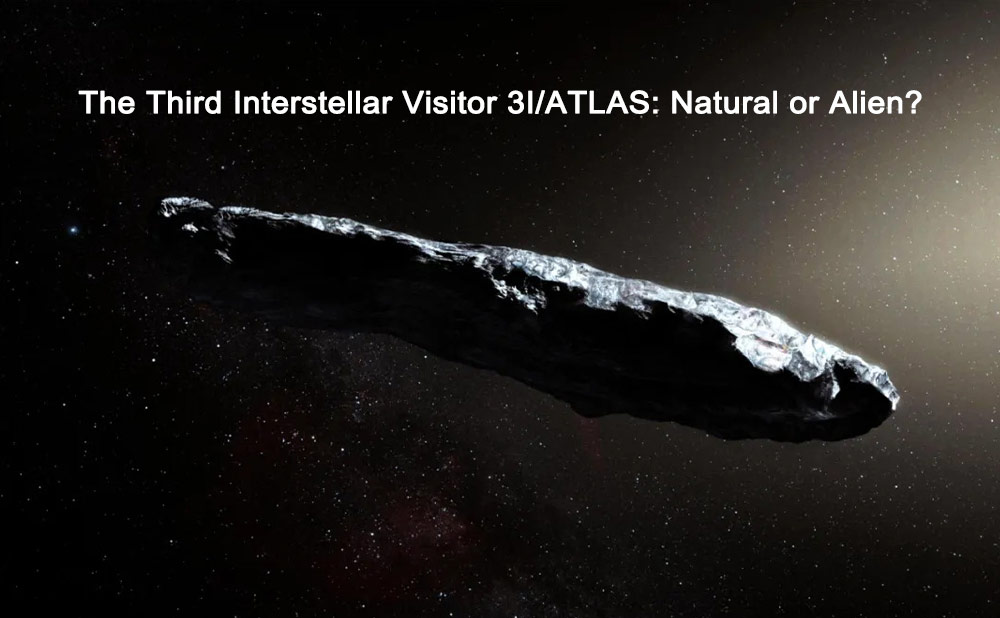
It’s a bird! It’s a plan! It’s…an intergalactic warship?
Or maybe a comet?
There has been news speculation on what seems to be a comet called “3I/ATLAS”, but it also to a lot of people appeared to be like a spaceship for the way it acted towards the sun. Is it a spaceship with aliens inside? Is one of our most major fears that humans dwell on about to come true?
Should we start preparing for an alien planet rule?
Scientists gave 3I/ATLAS its name because it is the third interstellar object found passing through the solar system and was discovered by NASA’s “ATLAS” survey scope this summer. It was first discovered in July of 2025 from NASA’s funded ATLAS survey through a telescope in Chile and noticed how it was being pulled by the sun’s gravity. ATLAS had an approximate speed of 153,000 miles per hour, which makes it known as a “Perihelion” and it will leave again from the planet with the same speed that it arrived with. NASA scientists also claim that it is an interstellar, or occurring in between stars because of its “high velocity and its trajectory.” In October of 2025, ATLAS passed over the Sun and was visible on Earth and is still in observation on Oct. 31, said press release from NASA.
Some people, particularly a Harvard scientist named Avi Loeb, think the interstellar object 3I/ATLAS could be an alien spaceship due to its unusual characteristics, such as a “heartbeat”-like pulsing and a bizarre trajectory. In his blog on Medium, he writes wiht a lot of math equations, that “Over the past month, images of 3I/ATLAS showed multiple jets. If the mass loss in the jets is pulsed periodically, the resulting coma would display periodic variability in its scattering of sunlight.”
NASA disagrees with his conclusions.
Why is it a comet and not a spaceship or even an asteroid? As far as NASA is concerned, “The colors, speed, and direction are all what we expect from a comet.” Well, they provide some evidence showing that it is more active due to its “icy nucleus” and a coma, or in other words a bright cloud of gas and dust surrounding a comet when it is approaching the sun.

However, one specific group astronomy organization named “Amateur Astronomers Association,” gets more specific in explaining not only that 3I/ATLAS is a comet, but there is something else that everyone is overlooking. The Amateur Astronomers Association delivered a post on Facebook on Oct. 26 stating what they think of and why they believe in sharing to NASA overall that it is a comet. For the most part, they addressed calmly how “The anti-tail visible in some photos of Comet 3I/ATLAS, our current interstellar visitor, is one of the ‘anomalies’ that Avi Loeb sites as evidence that this comet is an extraterrestrial spacecraft.”
However, more importantly, they believe that not only is this not a spaceship, but they believe strongly that “it isn’t anomalous at all but a feature of many comets.”
Does this mean that there are many comets into one? How would this be possible? Two common questions asked by many of their followers.
The Amateur Astronomers Association continue to provide a link on Facebook, taking it further to insist on ATLAS to be nothing but comets that came together to confuse us and simply “provoke another scare.” The link they provide is a 25 minute TED Talk from britastro.org through a speaker named Dennis Grazinski, another one of their Amateur Astronomers who provided information first hand on reasons of their beliefs for it being a comet.
Grazinski goes to tell us how “It appears to be a Comet Anti-Tail through photographic, contemporary, and digital observations.” He then explains that when an Anti-Tail’s appearance is affected, it can look more spectacular and shouldn’t be taken threateningly. It is from reasons being how it appears to be “an apparent spike extending from the coma towards the Sun, and therefore in an opposite direction to the gas and dust tails.”
Grazinski then says when the comet passes Earth through its orbital plane, “this disc is seen side on, and appears as the characteristic spike. The other side of the disc can sometimes be seen, though it tends to be lost in the dust tail.” He then gives different references to convince us further that it still had characteristics to a comet and more.
He compares our current comet and its anti-tail to older pictures through windows of a “Skylab” mission through the observances of astronaut Edward Gibson in December of 1973. Grazinski is still confident that in the current era, our technology uses more sensitive and larger ccd chips to allow us to record comet anti-tails more often while being able to capture the more stunning colors. There are even certain websites or softwares that officials use themselves to check on comet tails’ orientations more closely. Lastly, Grazinski concludes how they highlight that “We have gone from a situation where this cometary feature was rather a mysterious one to one where we can confidently predict when an anti-tail will be seen on any comet at an apparition.”
In other words, scientists technology is more resourceful in our present day compared to back then, making them more confident in forming answers since they have more to work with. Especially now when they study comets specifically, they have previous work to compare it with, but can look at them more clearly.
Therefore, thankfully it appears to these organizations that it was never a spaceship to begin with and was proven to be a comet through another one of their several astronomy organizations named the “Westchester Amateur Astronomers,” a nonprofit organization open to people of all ages with the desire to learn about Astronomy. They are members of the NASA night sky network and pointed out an irregularity in this comet. According to the WAA, this comet had an unusually high amount of CO2 (carbon) and H20 (water) ratio and also posses nickel compounds, which is what led to a more heated debate of what kind of comet this is.
It was stated from the Amateur Astronomers Association that at the end of the day, the comet “doesn’t appear to have any type of threat against our planet” and that it is “simply passing through our solar system”…or at least that’s what we believe for now.