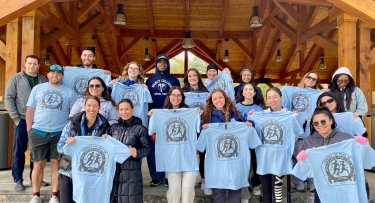
In a room filled with powerful voices representing some of the world’s largest nations, the students from Mercy University understood something important before the first speech was ever delivered: influence is not always measured by size.
And sometimes, the real challenge is having the courage to speak up at all.
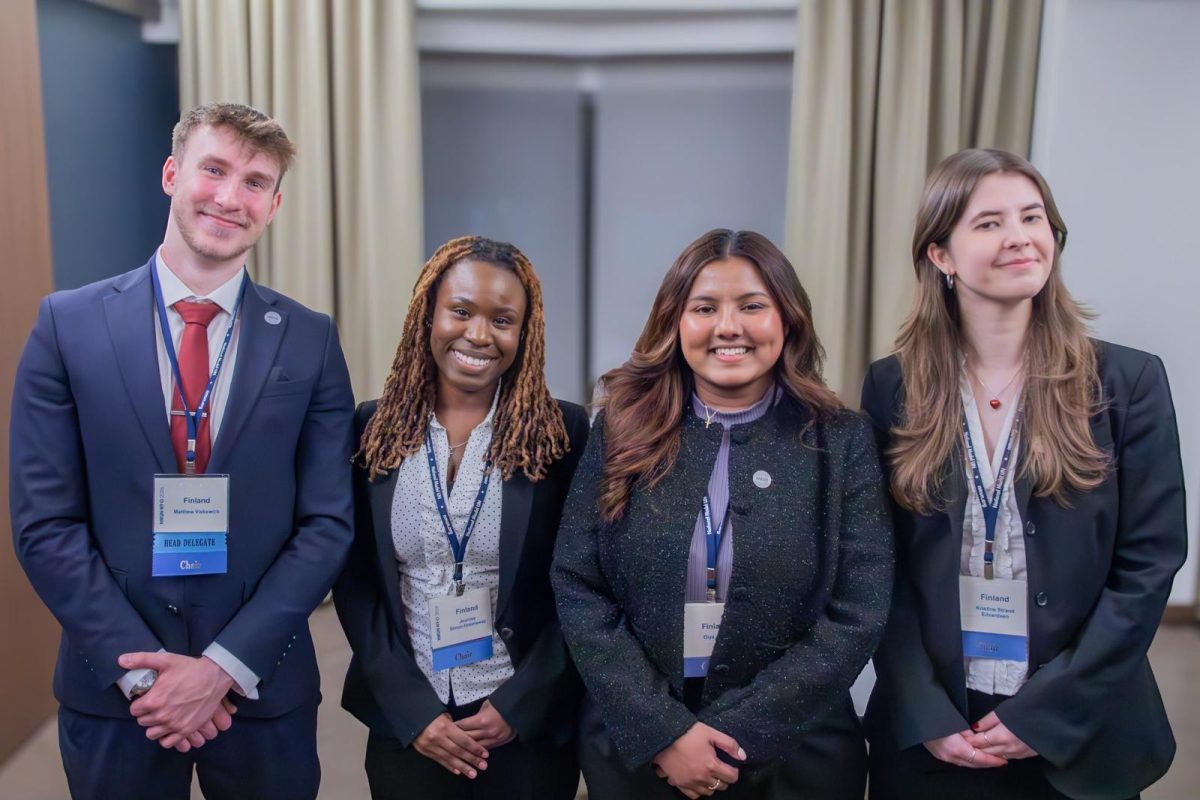
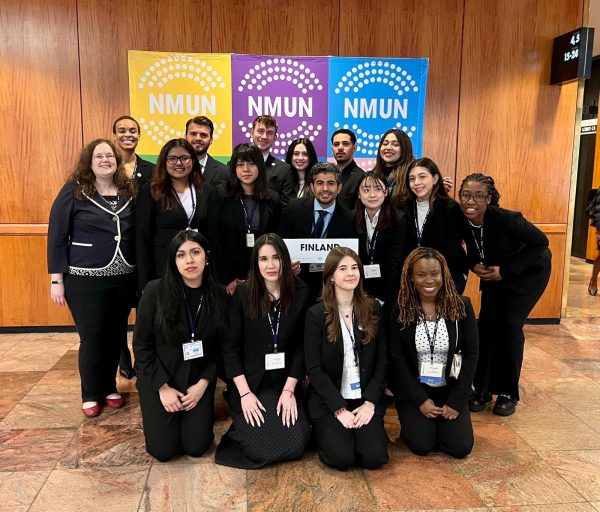
Representing Finland at this year’s Model United Nations conference from April 6 to 10, the Mercy delegation stepped into a global conversation where diplomacy, preparation, and confidence mattered more than population totals or political power. Surrounded by delegates portraying world superpowers, the students embraced the challenge of giving a smaller nation a meaningful presence on the international stage. In doing so, they won the conference’s Distinguished Delegation Award. 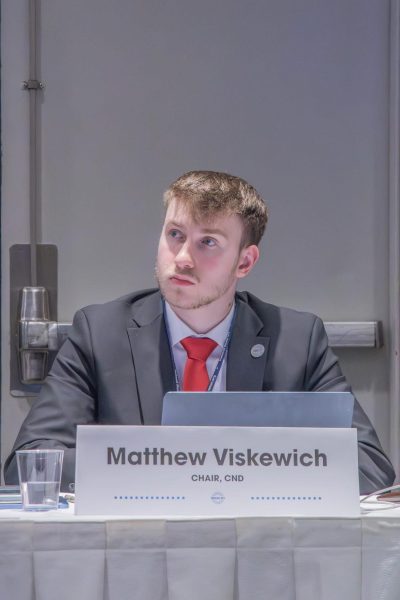
Journey Simon-Greenaway, a junior majoring in international relations and diplomacy, said negotiating with world powers requires creativity, flexibility, and a willingness to merge ideas.
“But in committees like the Security Council, they are more cautious about what we are agreeing to,” said Simon-Greenaway, who was serving her fourth semester on the team and served as Deputy Head this semester. “Smaller countries are more open to ideas than others.”
For many members of the team, the experience became about more than policy debates and resolutions. It became an exercise in finding their own voice. Every speech delivered, every negotiation entered, and every point defended reminded the students that leadership is often built in moments when people choose to stand up and contribute, even when the room feels bigger than they are.
Matt Viskewich, a senior international relations and diplomacy major, has served on the Model UN team for four years semesters at Mercy. This year, he served as the team’s head delegate. He said the experience has opened his eyes to the world of real-life negotiation and how effectively many countries play their roles.
“There are some policies that countries won’t sign because of their politics,” he said, referring to disagreements between Member States. “It’s very complex to reach a resolution that works for everyone. But it’s a harsh reality. It’s a great lesson for our future experiences. This is what happens in the world.
But most of the time, he said, everyone remains diplomatic while trying to reach resolutions that work for all.
In representing Finland, the Mercy students discovered that smaller nations are often among the most respected in diplomacy because they listen carefully, think critically, and speak with purpose. Finland is a member of the European Union and is known for being a leader in technology and environmental innovation. The country also holds the highest happiness ranking in the world.
“They’ve figured a lot out,” said Viskewich. “Their economy is strong, they are developing new environmental technologies, and they have historically maintained neutrality before recently joining NATO. They have a lot to contribute to the UN.”
Finland occupies a delicate position in global politics, he said. Historically associated with neutrality and strong support for diplomacy and non-proliferation, the nation recently joined NATO amid rising tensions in Europe.
“They are changing their stances and looking for the protection NATO gives them,” he said.
Model UN is a mock diplomatic conference in which students assume the roles of ambassadors representing countries from around the world. Participants debate global issues ranging from climate change and humanitarian crises to international security and economic development while working together to draft resolutions and negotiate solutions. More than just a public speaking exercise, Model UN challenges students to research world affairs, think critically under pressure, collaborate with people from diverse backgrounds, and practice diplomacy in an environment that mirrors the real United Nations.
Many team members held leadership and committee chair positions. This led to more preparation and responsibility than usual, as they had to prepare not only for their country but also for their committees.
Diya John, a senior biology major, said the heart of Model UN revolves around drafting resolutions.
“Resolutions need sponsors and signatories, meaning countries must support or at least agree to debate the proposal. A key part of the experience is negotiation with other delegations, explaining our ideas, and convincing them that our solutions are realistic, fair, and beneficial to everyone involved,” she said. “We also have to make sure there are no conflicts of interest and that the policies we support align with the goals and values of the country we represent. Diplomacy is really about communication, compromise, and finding solutions that multiple nations can support.”
Kristine Edvardsen, a junior from Norway majoring in international relations and diplomacy, said one reason she wanted to study in New York was to participate in Model UN. She added that everyone on the team and at Mercy had been welcoming and made her feel like part of a family. Coming from a smaller country, Edvardsen said she was already familiar with negotiating on equal footing with global superpowers.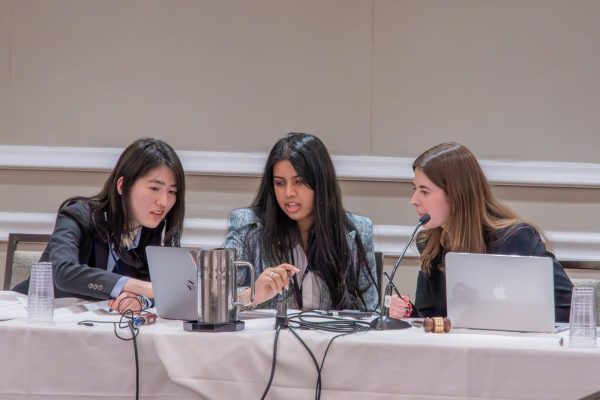
“The structure of the UN can make things difficult because of our size and because smaller countries only hold power in the General Assembly, but Norway is still a respected country with perspectives and priorities that differ from the United States. It was a great learning experience,” she said.
The team won the Distinguished Delegation Award and also won the following awards in the respective committees: Position Paper Award in Commission on Narcotic Drugs, Position Paper Award in Non-Proliferation Treaty Conference and Peer Delegate Award in Economic and Social Council. The following committees were chaired by Mercy students: Commission on Narcotic Drugs (Viskewich), Peacebuilding Commission (Simon-Greenaway), Human Rights Council (Edvardsen) and the Non-Proliferation Treaty Conference (John).
With all the opportunities to negotiate and debate solutions, many members also developed their own ideas about what changes the international community still needs to make.
“If I could change one thing, it would be bringing back stronger communication and diplomacy between world leaders,” Viskewich said. “The world runs on communication, but many of the larger countries are no longer using the United Nations the way they once did — as a place to sit down, discuss issues, and work toward solutions together. More world leaders need to come to the table diplomatically instead of allowing ego and emotion to drive decisions.”
Simon-Greenaway said she hopes more countries focus on addressing sustainability issues. 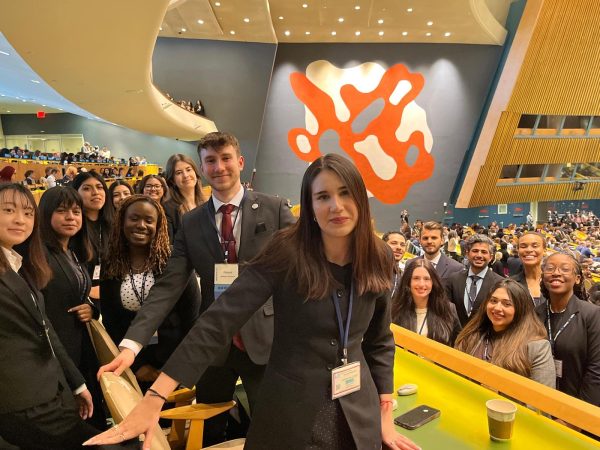
“We need to focus on more sustainable ways to solve global issues,” she said. “We only have one planet, and too often that is overlooked in favor of short-term solutions built around harmful materials and unsustainable products. If we continue down that path, we are going to keep damaging the planet, which is why we need to prioritize smarter, more sustainable practices moving forward.”
John focused her critique on the speed and effectiveness of global disaster response.
“Through the UN disaster response discussions, I saw many strong programs already in place, but I also noticed major gaps in what still needs to be addressed,” said John. “The experience showed me how important it is to create more global programs and solutions that go deeper into the issues and target the areas where support and resources are still lacking.”
Edvardsen said the structure of the United Nations needs to evolve because too much power and influence remain concentrated within the Security Council.
The United Nations Security Council is the most powerful body within the United Nations and is responsible for maintaining international peace and security. It deals with major global conflicts, wars, sanctions, ceasefires, peacekeeping missions, and threats to international stability. The five permanent countries are the United States, France, the United Kingdom, Russia, and China, while 10 additional countries are elected to two-year terms.
“When major countries refuse to communicate or rely on veto power, it becomes extremely difficult to create meaningful solutions to global problems,” she said. “While the UN was built for the world of 1945, the organization must adapt to better reflect the needs and realities of today’s international community.”
The students also thanked their faculty advisor, Prof. Elle DiLorenzo, for her support throughout the experience.
“She did a really great job, especially being thrown into the position under difficult circumstances,” they said. “She was always there for us, answered our questions anytime we needed help, and it was reassuring to have someone from the school there to guide and support us throughout the conference.”
Students interested in joining can speak to a PACT mentor or email [email protected].
The students said Model UN is worth joining not only for the conference experience, but also for the life lessons it teaches.
Ivanna Lewis-McGregor, a junior majoring in political science and legal studies who hopes to become a lawyer, said the experience taught her important professional and personal skills.
“I learned how important it is to dress professionally, maintain eye contact, and communicate clearly and properly,” she said. “Most importantly, I learned to be brave and stand by my principles.”
Mica Sosa Ortiz, a junior majoring in international relations and also Deputy Head delegate, said the experience taught her the importance of hustle, preparation, and time management. Throughout the conference, she moved between committees and helped wherever needed, gaining firsthand experience handling pressure and staying organized in a fast-paced diplomatic environment.
Jazmin Caamano, a sophomore majoring in international relations and diplomacy with a minor in legal studies, said the experience strengthened both her confidence and critical-thinking skills.
“Model UN helped me learn how to think on my feet and adapt quickly,” she said. “You come in prepared for one situation, but discussions can change instantly, so you have to be ready to respond and problem-solve in the moment.”
Caamano also said the experience helped her overcome her fear of public speaking.


“Public speaking was always a huge fear of mine,” she said. “I had spoken in front of groups of around 30 people before, but in my first semester, I was placed into GA3, which was a medium-to-large committee. I realized fear is just a mindset because everyone else is nervous too, since none of us know each other. It taught me not to worry so much about being judged and instead focus on contributing to the discussion.”
Edvardsen said the conference also reinforced the importance of listening to younger voices.
“We should listen more to young people because Model UN showed me that many students are open-minded and focused on creating real solutions,” she said. “Too often, younger voices are overlooked by older generations, but there should be more emphasis placed on youth perspectives and involvement in shaping the future.”
Isabella Gallego-Herrera, a sophomore majoring in legal studies and paralegal studies with a minor in communication, said Model UN changed the way she views her future after graduation.
“The experience made me want to pursue law school and potentially go into international law,” she said. “It opened so many doors for me in terms of negotiation skills, adapting to environments outside of my comfort zone, and growing as a person. It has also helped improve my communication and public speaking skills, and it’s something I want to continue being part of in future semesters.”
Simon-Greenaway said learning about Finland’s welfare system also stood out to her.
“People there pay higher taxes, but in return they receive benefits like free education and healthcare,” she said. “The system is designed to help everyone, especially those who are struggling, and it made me think more deeply about how stronger support systems can improve society.”
She added that the experience taught her how to accept constructive criticism and understand that not everyone will agree with her position.
Viskewich agreed, saying one of the biggest lessons he took away from Model UN was the importance of compromise and of understanding opposing perspectives.
“The world today has become very divided, with people and countries holding strong stances and refusing to meet in the middle,” he said. “Model UN taught me that progress only happens when leaders are willing to compromise, understand each other’s motives, and work together toward common ground.”